

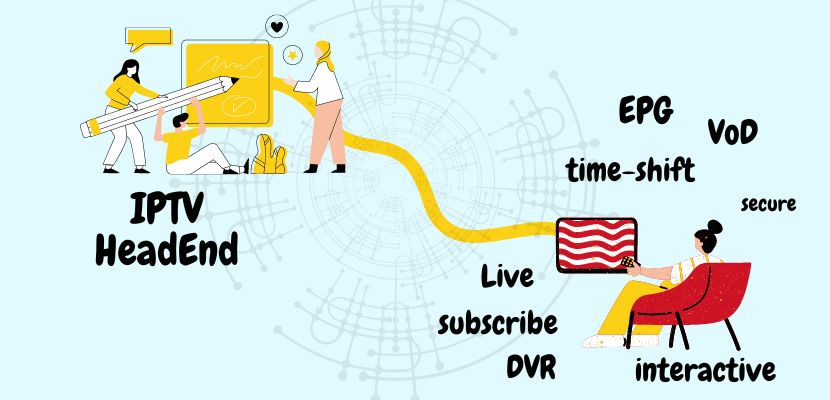
PTV, or Internet Protocol Television, is a method of delivering television services using internet protocol over a network infrastructure. As with traditional broadcasting, IPTV also involves multiple segments in its delivery chain, each playing a crucial role in ensuring smooth and seamless transmission of content to the end-users. Let's explore the various segments involved in an IPTV chain.
IPTV Head-End
IPTV headend refers to the central hub or equipment that is responsible for receiving, processing, and distributing television signals over an Internet Protocol (IP) network. It is the backbone of any IPTV service and plays a crucial role in the delivery of high-quality television content to users.

The IPTV headend typically consists of various components that work together to receive and encode live TV channels, video-on-demand (VOD) content, and other multimedia sources. These components often include satellite or cable receivers, encoders, transcoders, middleware servers, content delivery servers, and streaming servers.
Live TV
One of the key functions of an IPTV headend is to receive video signals from different sources and convert them into a digital format that is suitable for transmission over IP networks. for example, the headend responsible to gathering various video and audio feeds from multiple sources, such as satellite dishes, terrestrial antennas, ASI, IP, cable networks. These sources deliver live TV channels. The headend receives these signals and converts them into IP packets, which can be transmitted over an IP-based network infrastructure.

VoD
Video on Demand (VoD) is a popular feature of IPTV. With VoD in IPTV, viewers can access a vast catalog of movies, TV shows, documentaries, and other video content. They can choose their preferred content instantly through their IPTV service provider's platform or application. This ability to select and play content seamlessly on demand sets IPTV apart from traditional television broadcasting methods.
Users no longer have to adhere to scheduled programming; they can watch their favorite shows or movies whenever they prefer. This flexibility allows viewers to better manage their time and enjoy their preferred content without any restrictions.

In addition to the convenience factor, VoD in IPTV also offers a range of functions that enhance the viewing experience. Users can pause and resume playback at any time, rewind or fast forward within the video, and even restart a program from the beginning if they join in late. Such control over content consumption allows for a personalized and tailored viewing experience.
Moreover, IPTV's VoD service often incorporates innovative features like recommendations based on viewing history and preferences. This personalized suggestion system helps users discover new content that aligns with their interests and viewing habits.
interactive services offered by IPTV
Additionally, the headend can process and manage various types of interactive services offered by IPTV providers, such as electronic program guides (EPGs), time-shifted TV, and digital video recording (DVR) functionality. It also handles subscriber authentication and manages the encryption and decryption of the content to ensure secure transmission and prevent unauthorized access.
From Rare signals to IPTV
Converting rare video signals to IPTV can be a challenging task, but with the right equipment and understanding, it is possible to achieve seamless integration
Rare video signals refer to older or less common video formats that may not be readily compatible with modern IPTV systems. These signals could include analog formats like Composite, Component, or S-Video, as well as digital formats such as DVI or HDMI, SDI, IP. To convert these signals to IPTV, certain steps need to be followed:
1- Signal Source: The first step is to identify the rare video signal source. This could be an old VCR, a vintage gaming console, or any other device that outputs the video signal you wish to convert. Once the source is identified, an appropriate video encoder must be selected. The encoder will convert the analog or digital signal into a compressed digital format that can be easily transmitted via IP networks.
2- Compression and Video Encoder: The video encoder plays a crucial role in the conversion process. It takes the rare video signal as input and encodes it into a compatible format for IPTV transmission. the video signal needs to be compressed to reduce the file size for efficient transmission over IP networks. Common video compression standards like H.264 or H.265 can be used.
There are various types of encoders available on the market, ranging from standalone devices to software-based solutions. The choice of the encoder will depend on the specific requirements of the rare video signal and the IPTV system being used.
3- Streaming Protocol: the appropriate streaming protocol, such as RTMP (Real-Time Messaging Protocol) or HLS (HTTP Live Streaming) or UDP and RTP should be selected to ensure smooth delivery of the converted signal to IPTV clients.

4- IPTV Middleware and Server: Once the rare video signal is encoded and compressed, it needs to be delivered to IPTV clients. This requires a middleware solution that manages the delivery of the video streams to various devices. The middleware can also provide additional features such as program guides, on-demand content, and advanced user interfaces. It acts as the bridge between the video encoder and the IPTV streaming server.
5- Set-top Boxes or IPTV Apps: Finally, the converted rare video signal can be accessed by viewers through set-top boxes or IPTV apps on their devices. These devices or apps decode the received video streams and display them on the viewers' screens. Compatibility with the chosen streaming protocol and video compression standards is important to ensure proper playback of the converted signal.
Flexibility
Furthermore, the headend plays a crucial role in delivering the content to the end-users. It can distribute the encoded streams to different devices using various streaming protocols, such as Real-Time Streaming Protocol (RTSP) or Hypertext Transfer Protocol (HTTP). The headend can also adapt the streams based on the network conditions and the capabilities of the receiving devices.
Summary
In summary, the IPTV headend is essential for the successful operation of an IPTV service. It receives, processes, encodes, and distributes television signals, while also handling interactive services and ensuring secure transmission. It is a complex system that requires robust infrastructure and skilled professionals to maintain and operate efficiently.